


NGT deregulation: corporate interests take precedence over the will of the people

The European Parliament, with a majority of conservative and right-wing parties, has rushed through the new rules on genetically modified food and the patenting of genetically modified seeds. All the sound arguments, petitions, open letters, legal opinions, signatures, phone campaigns and protests appear to have fallen on deaf ears amongst MEPs. However, those affected by the new legislation are not giving up. Labels will become even more important for GMO-free produce in future, and the organic and GMO-free sectors will continue to produce without GMOs.

A black day for Europe’s farmers, the food industry and consumers
Many of the organisations involved and opponents of deregulation expressed their disappointment and criticism: ENGA Secretary-General Heike Moldenhauer sharply criticised the European Parliament’s decision to deregulate new genetic engineering (NGT):
“The European Parliament has sided with the biotech industry – and let down the food sector, small-scale breeders and farmers, as well as consumers. It has missed the opportunity to vote in the interests of the food sector and consumers, and has irresponsibly disregarded their right to know what is in their food. The Parliament has also failed to enact effective regulations against the patenting of plants and products derived from new GMOs.”
Despite repeated calls from the food sector, MEPs have failed to secure essential safeguards: traceability and labelling throughout the entire value chain, detection methods for all new GMOs, and effective measures to prevent patents on new GMOs that would be to the detriment of small-scale breeders, farmers and food businesses, Moldenhauer concludes.
Organic sector remains GMO-free
Through its European representative, the organic umbrella organisation IFOAM EU, the organic movement reaffirms its commitment to the production of food free from GMOs and warns that additional measures are needed to protect European seed sovereignty.
IFOAM states that the European Commission’s legislative proposal, now adopted at the final stage (the European Parliament), represents a huge step backwards for biosafety, transparency and freedom of choice; however, the mobilisation of the organic movement has secured important safeguards. NGTs remain banned in organic production; seed lots containing NGTs must be labelled so that farmers receive the minimum information necessary to avoid growing NGT crops.
Patent issue remains unresolved
The issue of patents on traits and gene sequences – which restrict access to genetic resources, hinder innovation, increase dependencies and can lead to growing market concentration within the food system – has not been resolved.
“The organic movement remains committed to the production of food free from GMOs and NGTs and will continue to advocate for systemic and open-source agroecological innovations to make entire farming systems more sustainable. The alleged benefits of NGTs are based on pure speculation, and we urge policy-makers to pay closer attention to who controls the technologies whose regulation they wish to lift, as well as to the impact of technologies such as NGTs on European food sovereignty.”
Jan Plagge, President of IFOAM Organics Europe
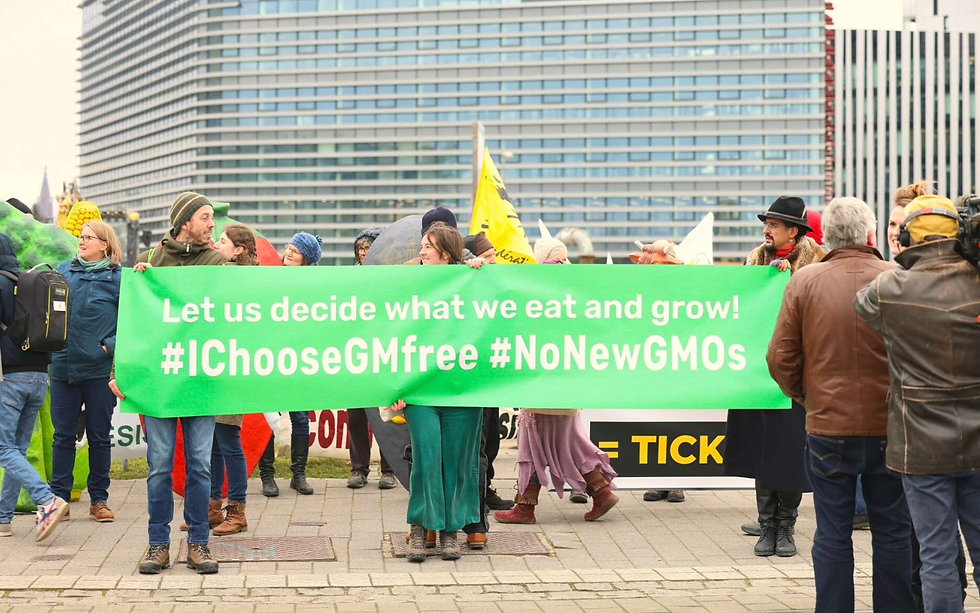
There is also great disillusionment at the Association for GMO-Free Food (VLOG). Managing Director Alexander Hissting comments:
“It is disappointing that MEPs have even pushed through the widespread abolition of GMO labelling for food and have not even managed to enforce an effective ban on seed patenting – contrary to what the Parliament itself decided just two years ago. Now, the voluntary ‘GMO-free’ and ‘organic’ labels must, and will, close this new legal labelling loophole. This is because the vast majority of consumers want clarity – even when it comes to ‘new’ genetic engineering (NGT) – as to whether it has been used in the production of their food. If GM technology could soon be present even in bread, beer, bananas or baby food, a ‘GM-free’ label will become even more important in future”.
The new rules have made ‘GM-free’ production more difficult and labour-intensive, but not impossible. “We will rise to the challenges and adapt our standards accordingly to continue reliably ruling out the use of NGT. Shifting this burden from the genetic engineering companies – and thus from those responsible – onto the food industry is unfair and has, unfortunately, been largely ignored by the majority of MEPs,” said Alexander Hissting. At the same time, he called for: “Federal Minister for Agriculture Rainer must now adapt Germany’s national GM regulations, in collaboration with ‘Ohne Gentechnik’ and the organic sector, so that they are protected against NGT contamination and can continue to successfully meet the high demand for GM-free food.” Together, these two sectors sold food worth around 36 billion euros in Germany in 2025.
The regulation comes into force 20 days after its publication in the Official Journal of the EU. Economic operators have two years to adapt to it and implement it. Until then, numerous technical and legal issues need to be clarified, such as rules on coexistence, documentation, liability issues and verification procedures. The new regulation could even be completely challenged in court once again, as several legal opinions and, most recently, a sensational court ruling in the UK have already shown, according to VLOG.
Author: Karin Heinze
Sources: ENGA, IFOAM EU, VLOG


Comments