


Global Organic Market hits All-Time High

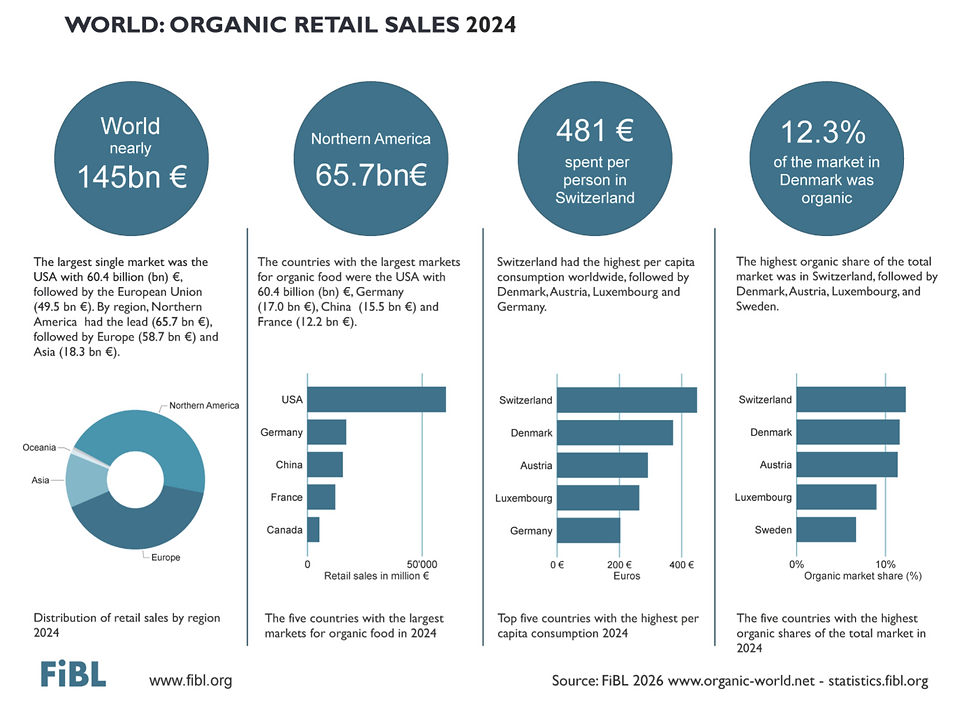
Also this year BIOFACH was the platform where important data from the organic markets around the world were published. “The World of Organic Agriculture: Statistics and Emerging Trends 2026”, the latest statistics, presented by the Research Institute of Organic Agriculture FiBL and IFOAM – Organics International, shows an ongoing stable upwards development of the global organic sector. In 2024, global retail sales of organic food and drink rose to 145.0 billion euros – an increase of 6.9 billion euros –, underlining resilient consumer demand across major markets. At the same time, the global organic farming area remained close to 99 million hectares, providing continuity in the production base.

Global retail sales rose to 145.0 billion euros in 2024
The United States remained the world’s largest market with 60,4 billion euros, followed by Germany with 17 billion euros last yea – a tremendous growth to 18.2 billion euros in 2025! Third biggest market 2024 for organic products is China with 15,5 billion euros of sales. Consumers are spending more on organic food and drink across key markets, sending a clear signal to producers, processors, and retailers that demand remains resilient. Switzerland recorded the highest per capita consumption worldwide at 481 euros per person the highest organic market share globally at 12.3 percent of total food sales in 2024 followed by Denmark and Austria.
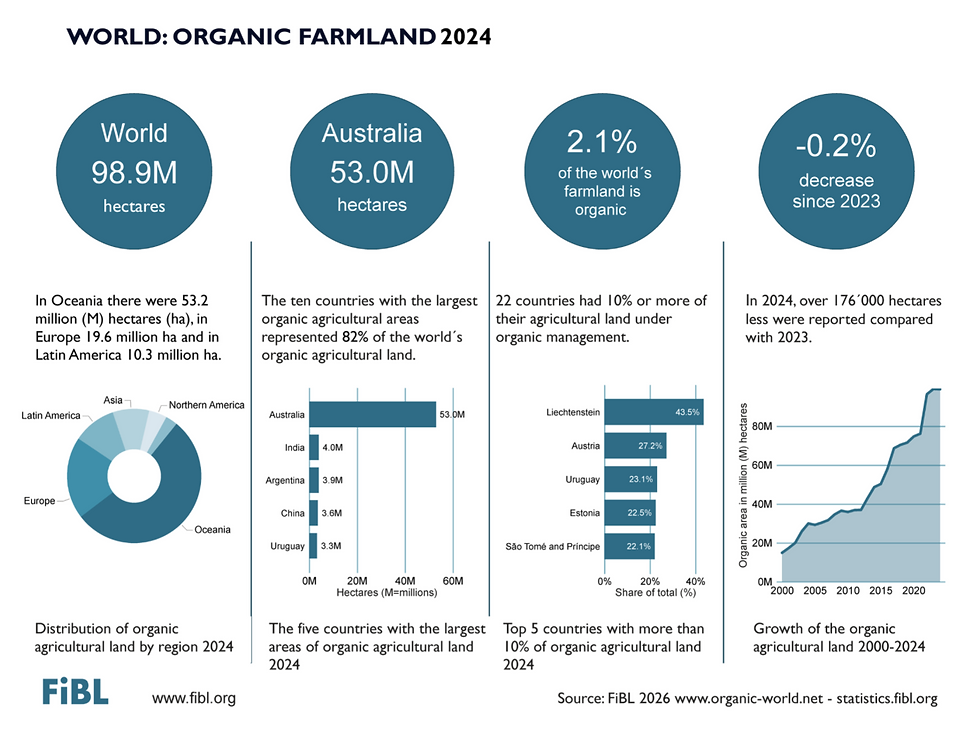
Almost 100 million hectares of organic farmland worldwide
According to the FiBL statistics organic farmland remained broadly stable at 98.9 million hectares, indicating continuity in the global production base. Australia had the largest organic agricultural area (53.0 million hectares), and Liechtenstein had the highest organic farmland share (43.5 percent).The number of organic producers reached 4.8 million worldwide.
In 2024, combined organic imports into the main organic markets, the EU and the United States, reached 5.9 million metric tons, reflecting strong market pull and increasingly connected supply chains (up 12.3 percent, by 0.6 million metric tons). The largest exporters to the EU and U.S. markets were Mexico, Ecuador, and Canada.
Author: Karin Heinze, BiO-reporter-International.net
Source: The World of Organic Agriculture 2026: Statistics and Emerging Trends is the leading global reference for organic sector data on land area, producers, markets and international trade, compiled by FiBL in cooperation with IFOAM – Organics International and national data partners. The yearbook can be downloaded at https://shop.fibl.org (item number 1861)


Comments